LiFePO4 Battery for Solar CCTV: Practical Sizing Guide
Learn how to size a LiFePO4 battery for solar CCTV in the Philippines, covering usable energy, autonomy, charging, heat, and monitoring.
By Maxsol Team

A LiFePO4 battery for solar CCTV should be selected by usable energy, expected night-time and bad-weather autonomy, and how quickly the solar array can restore the battery after a cloudy day. Battery amp-hour rating alone is not enough: the camera load, PoE switch or injector, wireless bridge, recorder, voltage conversion losses, and local solar conditions all affect the result.
For Philippine outdoor surveillance sites, plan for regular cloud cover, the rainy season, high ambient temperatures, and the possibility of several days with reduced solar harvest. The practical goal is not simply to keep a camera running overnight, but to maintain reliable operation without repeatedly driving the battery to low state of charge.
Why battery chemistry matters
LiFePO4, or lithium iron phosphate, is a battery chemistry commonly considered for solar-powered CCTV because it is well suited to repeated charging and discharging in properly designed DC power systems. Compared with some traditional lead-acid battery options, a LiFePO4 system can offer a more stable operating voltage through much of its discharge range and can be more compact for a given nominal energy rating.
For a 24/7 CCTV installation, the important benefit is not a claimed runtime. It is the ability to design around a predictable energy budget and to use battery management and charge-control functions appropriately.
A solar CCTV battery system needs more than battery cells. The full design should consider:
- A correctly sized solar panel or array for the daily energy demand
- A solar charge controller suited to the battery voltage and charging profile
- Battery protection and battery management functions
- DC output regulation for cameras, PoE equipment, routers, and wireless links
- Cable voltage drop, especially on long outdoor runs
- Enclosure heat, ventilation, moisture management, and physical security
- Monitoring of energy input, battery condition, and load consumption
LiFePO4 batteries are still not “fit and forget”. A system can underperform if the PV input is too small, the daily load is underestimated, the battery is exposed to sustained enclosure heat, or added equipment increases consumption after commissioning.
For solar CCTV in the Philippines, it is also important to separate power continuity from video retention. A battery may keep the camera and network online, but an NVR, edge storage device, or cloud uplink can have its own power and bandwidth requirements.
Capacity versus usable energy
Battery capacity is often quoted in amp-hours (Ah), while a CCTV power design is easier to assess in watt-hours (Wh). Watt-hours show the nominal amount of stored energy available at a given battery voltage.
The basic relationship is:
Nominal battery energy (Wh) = battery voltage (V) × battery capacity (Ah)
For example, a 12.8V 45Ah battery has a nominal energy rating of:
12.8V × 45Ah = 576Wh
However, nominal energy is not automatically the energy available to CCTV equipment. Actual usable energy depends on several system-specific factors:
- The battery management system’s low-voltage cut-off
- The operating voltage range accepted by the load
- DC-DC converter, PoE switch, or inverter losses
- Cable losses
- Ambient temperature
- Battery condition and age
- The reserve capacity kept to avoid deep discharge
- Whether the load rises at night, such as when infrared LEDs activate
Calculate the daily CCTV energy demand
Start with the actual continuous load, not the camera’s maximum label rating alone. Include every powered device at the remote site.
A simplified estimate is:
Daily load (Wh) = average load (W) × operating hours
For a 24/7 system:
Daily load (Wh) = average load (W) × 24
Suppose a site has an average combined demand of 18W from cameras, a PoE device, and a wireless link:
18W × 24 hours = 432Wh per day
That figure is only a starting point. It should be adjusted upward where applicable for:
- Night IR illumination or camera heaters
- PTZ movement and zoom activity
- PoE conversion losses
- Wireless radio transmit peaks
- Router, cellular modem, or recorder consumption
- Inverter standby consumption, if AC power is used
- Future camera ports or network expansion
Where possible, measure the real load over a full day and night. This is more dependable than sizing solely from nameplate power, particularly when cameras switch between day and night modes.
Do not treat the whole battery rating as runtime
A 576Wh battery and a 768Wh battery do not provide a fixed number of operating hours because each site has a different load and different system losses. A 10W camera-only setup is very different from a multi-camera PoE node with a radio link and an NVR.
Instead, use this planning approach:
- Calculate or measure total average load in watts.
- Convert the required operating period into watt-hours.
- Add an allowance for conversion and cable losses.
- Reserve energy rather than designing for routine full discharge.
- Check whether solar generation can replace the previous day’s consumption.
This method helps prevent a common error: choosing a larger Ah number without confirming whether the system’s nominal voltage, output design, and solar charging capacity match the application.
Autonomy and recharge planning
Autonomy is the time a solar CCTV system can operate when solar input is low or unavailable. For Philippine projects, autonomy planning should account for more than one clear night. Monsoon conditions, shaded locations, soiled panels, and prolonged rain can all reduce energy harvest.
A useful design question is:
How many hours or days must the CCTV site remain operational if solar charging is below expectation?
The answer depends on the security objective. A temporary access point may accept a shorter autonomy period than a perimeter camera protecting a remote facility. Critical sites may also need a backup power source, a larger solar array, reduced non-essential loads, or a separate resilience strategy.
Size for the energy deficit, not only night operation
A solar CCTV site may charge during the day and discharge at night, but a cloudy day can create an energy deficit even before sunset. If daily solar harvest is lower than daily consumption, the battery will continue to lose charge across successive days.
For this reason, assess both sides of the energy balance:
| Planning item | What to determine |
|---|---|
| Daily consumption | Total average load in Wh per day, including conversion losses |
| Solar harvest | Expected energy collected at the actual mounting angle, orientation, and shading condition |
| Battery reserve | Energy retained for night operation and periods of poor weather |
| Recharge window | Whether available sunlight can restore the battery after discharge |
| Seasonal conditions | Reduced harvest during frequent rain or overcast periods |
| Expansion allowance | Additional power needed for future cameras, radios, or PoE ports |
A battery that is adequate on a bright day may be undersized when solar input is reduced for several days. Conversely, installing a larger battery without increasing solar input can lead to slow recovery after extended discharge.
Charging equipment must match the battery system
The charge controller is a key part of a LiFePO4 solar CCTV system. It must be configured for the battery’s required charging parameters and connected according to the system design. Incorrect charging settings can reduce performance or cause protective shutdowns.
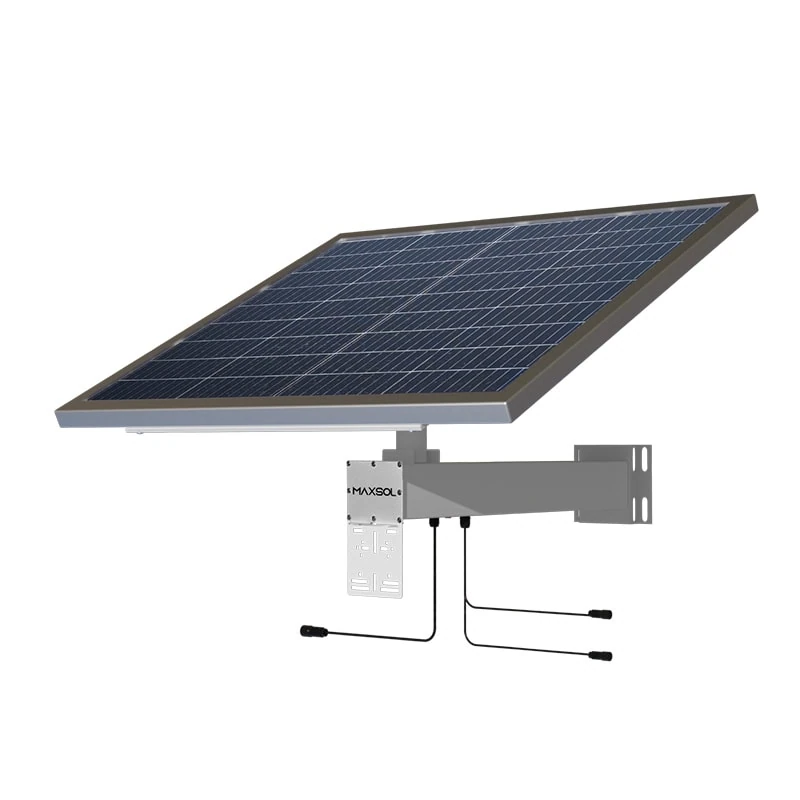
The documented Maxsol CS6030 configuration includes a 12.8V 30Ah 384Wh LiFePO4 battery and MPPT control. For small, carefully measured loads, review the CS6030 solar system alongside the project’s actual daily energy calculation.
Do not assume that an MPPT controller alone solves an undersized solar design. It can help manage available PV power, but it cannot generate energy that shading, weather, panel orientation, or limited panel area prevents the system from collecting.
Temperature protection and monitoring
Outdoor solar CCTV equipment in the Philippines may experience high daytime enclosure temperatures, direct sun exposure, heavy rain, humidity, and rapid weather changes. Battery installation should therefore be planned as an enclosure and thermal-management issue, not only an electrical issue.
Manage heat inside the outdoor cabinet
A dark or sealed outdoor box in direct sunlight can become much hotter than ambient air. Sustained heat can affect battery condition and other electronics, including PoE switches, power converters, routers, and storage devices.
Good installation practice includes:
- Mounting the cabinet away from direct afternoon sun where site conditions permit
- Providing suitable shading without blocking the solar panel
- Using an enclosure appropriate for the outdoor environment
- Maintaining cable glands, seals, and drainage correctly
- Allowing design-appropriate ventilation or heat management
- Keeping the battery away from heat-generating electronics when the enclosure layout allows
- Avoiding tightly packed wiring that obstructs service access or heat dissipation
Do not assume a battery or cabinet can tolerate any temperature simply because it is intended for outdoor projects. Confirm the permitted charge and discharge temperature ranges for the selected battery and all connected equipment.
Confirm low-temperature charging behaviour
Most Philippine lowland sites are more likely to face heat and humidity than freezing conditions. However, upland installations, cold-storage-adjacent areas, or unusual project environments may require a specific review of low-temperature charging limits.
LiFePO4 batteries can have charging restrictions at low temperatures. The exact response may depend on the battery management system, controller settings, and battery design. Confirm whether charging is automatically blocked or limited outside the approved temperature range; do not rely on an assumed protection threshold.
Monitor energy, not voltage alone
Voltage is useful, but it is not a complete picture of battery state, particularly when loads switch on and off or when solar charging is active. A practical monitoring plan should capture:
- Battery voltage
- Charge and discharge current
- Solar input or controller status
- Load current or total load power
- Battery state of charge, where supported
- Fault and low-voltage events
- Enclosure temperature where heat exposure is a concern
- Communications status for remote CCTV sites
Event records are especially useful. If a camera goes offline overnight, monitoring can help distinguish among low battery protection, a network failure, an overloaded PoE output, a controller issue, or a camera fault.
Compare approved LiFePO4 capacities
The following battery capacities are documented for the listed Maxsol solar system models. These nominal energy figures are useful for comparison, but they do not indicate a guaranteed runtime. Final sizing must use the actual load, solar conditions, system losses, and desired autonomy.
| Solar system model | Documented LiFePO4 battery | Nominal battery energy | Suitable comparison question |
|---|---|---|---|
| CS6030 solar system | 12.8V 30Ah | 384Wh | Is the measured load low enough for the required reserve and weather margin? |
| CS8040 solar system | 12.8V 45Ah | 576Wh | Does the extra stored energy cover the expected night and reduced-sun period? |
| CS12060 solar system | 12.8V 60Ah | 768Wh | Is this energy level appropriate for a larger PoE and wireless equipment load? |
| CS200100 solar system | 12.8V 100Ah | 1280Wh | Can the site’s PV design recharge this capacity while supporting the required autonomy? |
The comparison should begin with watt-hours, then move to the full site design. A 1280Wh battery has more nominal stored energy than a 384Wh battery, but the larger option is only appropriate if the power demand, solar input, enclosure space, mounting design, and recovery time support it.
Questions to verify with the system designer
Before specifying a LiFePO4 battery for solar CCTV, ask for a clear load and energy design rather than a general runtime estimate.
Load and network questions
- How many cameras will operate continuously?
- What is the measured average and peak power draw of each camera?
- Do cameras enable IR lighting at night, and how much does that increase power use?
- Are PTZ cameras, heaters, wipers, illuminators, or audio devices included?
- Is power supplied through PoE, direct DC, or an AC inverter?
- What are the power requirements of the PoE switch, injector, wireless bridge, router, and modem?
- Will an NVR or edge recorder be located in the same cabinet?
- Is there allowance for future camera ports or network equipment?
Solar and battery questions
- What is the expected daily energy use in Wh?
- How was the expected solar harvest calculated for the actual site?
- Is the panel exposed to seasonal shading from trees, buildings, poles, or new construction?
- What autonomy period is required during heavy cloud cover or rain?
- What battery reserve is being maintained before low-voltage disconnection?
- How long will it take to recharge after a low-sun period?
- Are the charge controller settings correct for the selected LiFePO4 battery?
- Is the battery protected from unsuitable charge and discharge temperatures?
Installation and maintenance questions
- Is the outdoor enclosure positioned to reduce solar heat gain?
- Are the camera, switch, battery, and controller accessible for safe servicing?
- Has voltage drop been calculated for long DC and PoE cable runs?
- Are surge protection, grounding, and cable routing addressed in the site design?
- What monitoring data can be checked remotely after commissioning?
- What alarm or maintenance action is triggered by repeated low-battery events?
Common solar CCTV battery sizing mistakes
Several recurring mistakes can cause downtime even when a battery has a seemingly large capacity.
Sizing only for the camera. The network switch, radio, modem, converter, and recorder can consume as much energy as the camera load or more.
Using peak sunlight assumptions. Design based on realistic site conditions, including cloudy weather and partial shading, rather than an ideal clear day.
Ignoring night-time load changes. IR LEDs, illuminators, and increased radio activity can raise the load after sunset, when the battery is doing all the work.
Counting every nominal watt-hour as usable. Maintain a practical operating reserve and account for system losses.
Increasing battery size without reviewing PV charging. A larger battery can take longer to recover if solar collection is not also sufficient.
Putting all equipment in an overheated cabinet. Battery, network, and power electronics performance can all be affected by enclosure temperature.
Monitoring only whether the camera is online. A camera may reconnect after sunrise, masking an overnight energy shortfall. Track battery and solar data to identify the root cause.
A properly sized LiFePO4 battery for solar CCTV supports dependable 24/7 surveillance by matching stored energy, solar charging, equipment load, environmental protection, and monitoring. Compare the linked Maxsol models against your port count, load, cable distance, power requirements, site environment, and management needs before finalising the system design.